Growing Equity: Councilmember Ben Bartlett and the FARM Project’s Vision for Food Resilience.
ACTION CALENDAR
May 8, 2023
To: Honorable Mayor and Members of the City Council
From: Vice Mayor Ben Bartlett (Author), Mayor Jesse Arreguin, Councilmember Kate Harrison, and Councilmember Sophie Hahn (Co-Sponsors)
Subject: Berkeley Food Utility and Access Resilience Measure (FARM)
RECOMMENDATION
1. Refer to the City Manager the task of protecting the City’s food supply from natural disasters and economic disruptions by promoting the efforts of community-based organizations to design and implement an integrated local food production and distribution system for the City of Berkeley.
2. Refer to the City Manager and the Office of Economic Development resources to research and return to the Council potential economic incentives for non-profits, agricultural producers, and small businesses to partner with the City of Berkeley to support the implementation of FARM.
3. Adopt a resolution to support the goals of the FARM initiative and the development of hyperlocal urban food production with community-based organizations.
BACKGROUND & CURRENT SITUATION
To support food resilience for the residents, the City of Berkeley should adopt a “hyper-local” in place of a “local” approach to food production and distribution. Food labeled as “local” receives its definition from a provision of the Farm Act from 2008. Under that law, a food item is deemed
local when “the total distance that the product is transported is less than 400 miles from the origin or the product.”1 Hence, under this definition, fruits and vegetables sourced from Southern California are still considered “local” to the City of Berkeley. Given the recent floods that have destroyed many homes, lands, and crops, there is an urgent need to develop a program for stronger food resilience in California.2
The FARM initiative, on the other hand, supports the development of hyper-local urban food production to support community resilience in Berkeley. Hyper-local produce is food grown right in a community’s backyard and available for purchase and consumption at local markets and restaurants. The benefit of being a hyper-local food supplier is that produce can be harvested and delivered on the same day. This results in food being fresh longer than produce delivered from long distances and lessen the risk of supply chain disruption. For example,
1Food, Conservation, and Energy Act of 2008 (June 18, 2008)
2Staff, RICH RODRIGUEZ |. KMPH. “‘It’s Just a Mess’: California Farmers Growing Concerned over Lingering Flood Waters.” KRCR, 27 Mar. 2023,
https://krcrtv.com/news/videos/its-just-a-mess-california-farmers-growing-concerned-over-lingering-flood-waters-pistachio-trees-kin gs-county-farm-breckenridge-corcoran-tule-river-deer-creek-cal-fire.
2180 Milvia Street, Berkeley, Floor 5, CA 94704 ● Tel: (510) 981-7130 ● E-Mail: bbartlett@cityofberkeley.info 1
Gotham Greens in New York City produces hyper-local commercial food via urban rooftop gardens. Opportunities for hyper-local and building “Agri-hoods” (urban neighborhoods focused on local food production) continue to grow. This includes communities integrating food production into neighborhood design, with hyper-local methods of urban agriculture including SPIN Farming, (small plot intensive) vertical farming, and rooftop growing. According to Curtis Stone, SPIN farming expert and author of “The Urban Farmer” and, urban farmers can earn $75,000 on 15,000 Square Feet and can grow between 6,000 to 7,000 pounds of food on 1/10th of an acre. The city of Berkeley is 17 square miles, or approximately 11,000 acres.3 One scenario envisions using distributed local production and SPIN farming to cultivate 5% of Berkeley’s total acreage.Assuming a yield of 7,000 pounds of produce per 1/10th of an acre, the scenario would provide 38 Million pounds of fresh produce a year. While not enough to fully support the entire city, it is a significant step forward to food resilience, particularly for the 20,000 low-income individuals in the community.
By March of 2023, the emergency allotment for low-income individuals and households enrolled in the Federal Supplemental Nutrition Assistance Program (SNAP) will end.4 This change comes at time of historic inflation, with food prices increasing by 10%. According to5 Cal Policy Research, 10% of students in the UC System access SNAP Benefits, which helps students make ends meet while attending university. The FARM Initiative sets the framework to not only increase the production and supply of fresh produce in Berkeley, but also to facilitate group buying power for SNAP participants in Berkeley, to help lower the cost, support local growers, and help the community eat healthier.
Berkeley is home to the local foods revolution, yet thousands of Berkeley residents are food insecure. Natural disasters and economic downturns exacerbate this insecurity; and climate change increases the likelihood and severity of food supply interruption.
Berkeley has the framework for food resiliency through its successful farmers’ markets; service providers who have been providing meals to homeless individuals since the early 1970s; community groups like Consider the Homeless and Food Not Bombs, which distribute food to homeless populations; and the Berkeley Food Network (BFN). Founded in 2016 in collaboration with community organizations, BFN promotes access to nutritional food by using “innovative, community-centered solutions to build a more sustainable, resilient, and equitable food system.”6
3 Maki, Olivia, How Urban Farmers Can Earn $75,000 on 15,000 Square Feet (February 29, 2016)
4“MoCorvey, J., and Rob Wile. “”With Foods Stamp Cuts just Days Away, Millions of Americans Brace for Tougher Times Int He Grocery Aisle” Feb 26, 2023
https://www.nbcrightnow.com/national/with-food-stamp-cuts-just-days-away-millions-of-americans-brace-for-tougher-times-in/artic le_3e070c3e-b616-11ed-a950-0f3c90f9985b.html
5 California Community College and University of California student participation in CalFresh food benefits (February 23, 2022) https://www.capolicylab.org/california-community-college-and-university-of-california-student-participation-in-calfresh-food-benefit s/
6 Berkeley Food Network, About BFN, (last accessed Jan. 5, 2023), https://berkeleyfoodnetwork.org/who-we-are/about/.
2180 Milvia Street, Berkeley, Floor 5, CA 94704 ● Tel: (510) 981-7130 ● E-Mail: bbartlett@cityofberkeley.info 2
The City should preemptively safeguard its residents from a food supply chain interruption through a Food Utility and Access Resilience Measure (FARM). The FARM initiative achieves food resilience by (1) developing hyper-local food production sources; (2) connecting these sources to each other and local community hubs, including food banks, grocery stores, restaurants, and schools; and (3) powering hyper-local food production sources using renewable energy with battery backup storage that can operate despite disruptions to the main power grid. These efforts will be assisted by the requirements under SB 1383, which requires restaurants and grocery stores to compost left-over food. These businesses would benefit from having a lower cost method of disposing of still fresh but excess food.
1. Community resilience
Government planners are faced with an emergent set of existential threats to populations and infrastructure. Many threats stem from the rapid advancement of climate change, with the increasing frequency of extreme weather events, such as hurricanes, tornadoes, floods, droughts, and fires. In addition to climate disasters, disaster preparedness must brace for pandemics, electrical failure, targeted violence, and cyber attacks, water and energy infrastructure failure, sea level rise, supply chain breakdown, and food insecurity. These threats arise from a variety of sources and therefore require a systems-level approach that addresses all the possible points of failure in an urban food supply chain.
Accordingly, policymakers are embracing new emergency preparedness and disaster mitigation models centered on equity and resilience at the community level (community resilience). Community resilience refers to the ability of a community to withstand and recover from disruptions, such as natural disasters, economic downturns, or health crises. Community resilience leverages local community networks; local knowledge; local communication channels; local resources; and local bodies of governance and leadership.
2. Food resilience
One component of community resilience is food resilience, which refers to the ways in which a community can ensure its members have access to healthy and nutritious food, even during times of crisis. This can involve a variety of strategies, such as growing food locally, supporting local agriculture, building community gardens, developing food storage and preservation facilities, and forming relationships with local food producers. By building a resilient local food system, communities can reduce their reliance on remote sources of food and ensure that they are able to continue providing sustenance for residents, even during challenging times.
FARM’s development of a local, resilient food system empowers the City of Berkeley to achieve one of its key Climate Action Plan goals. Adopted in 2009, the Climate Action
2180 Milvia Street, Berkeley, Floor 5, CA 94704 ● Tel: (510) 981-7130 ● E-Mail: bbartlett@cityofberkeley.info 3
Plan calls for the “majority of food consumed in Berkeley” to be produced locally.7 By creating a network of local food production, FARM lays the foundation for local, higher yield production of nutritious food that the City can scale up to meet its goal. This environmental objective is intertwined with resilience. Lowering the distance between the location of production and consumption improves the ability to supply food to the people of Berkeley despite disruptions to transportation.
The State of California and the US Federal Government are increasingly incorporating food resilience in disaster planning and view food security as foundational to any resilience effort. For example, California’s budget for fiscal year 2022-23 allocates $477 million toward agricultural resilience measures, including climate-friendly agriculture, soil health, water efficiency, and wildfire prevention.8
Additionally, California’s Strategic Growth Council (SGC) has called for local-level resilience through its Community Resilience Centers (CRC) program. The CRC program will “fund new construction and upgrades of neighborhood-level resilience centers to provide shelter and resources during climate and other emergencies . . ..”9
At the federal level, President Joe Biden signed National Security Memorandum-16 (NSM-16) in November 2022 “to strengthen the security and resilience of United States food and agriculture.” NSM-16 provides a process for identifying and assessing threats to food security, strengthens relationships with the private sector, and promotes systems that respond to disruptions in the food sector.10
3. Food is a fundamental human right.
It has been often said, “There are only nine meals between mankind and anarchy.” And Vladimir Lenin said, “Every society is three meals away from chaos.” Like air and water, food is essential for survival and the only commodity that cannot be postponed. When
social, economic, or ecological barriers block access to nutritious food, people suffer. Food-insecure individuals have higher rates of mental health issues, and hungry children attain lower academic achievement than their peers.11
The United Nations recognizes the fundamental right to food for all. At its core, this right is the right to “all nutritional elements” necessary to live a “healthy and active life” and
7 City of Berkeley, Berkeley Climate Action Plan, (June 2, 2009),
https://berkeleyca.gov/your-government/our-work/adopted-plans/berkeley-climate-action-plan.
8 Arohi Sharma, FY22 California Budget Invests in Agricultural Resilience, NRDC (Sep. 21, 2022),
https://www.nrdc.org/experts/arohi-sharma/fy22-california-budget-invests-food-farm-resilience.
9 Cal. Strategic Growth Council, SGC Launches Development of Community Resilience Centers (CRC) Program, (July 5, 2022), https://sgc.ca.gov/news/2022/07-05.html.
10 See National Security Memorandum on Strengthening the Security and Resilience of United States Food and Agriculture, (Nov. 10, 2022), https://www.whitehouse.gov/briefing-room/presidential-actions/2022/11/10/national-security-memorandum-on-on-strengthening the-security-and-resilience-of-united-states-food-and-agriculture/.
11 Arohi Pathak, Ryan Richards & Marc Jarsulic, The United States Can End Hunger and Food Insecurity for Millions of People, Center for American Progress Action Fund (Aug. 11, 2022),
2180 Milvia Street, Berkeley, Floor 5, CA 94704 ● Tel: (510) 981-7130 ● E-Mail: bbartlett@cityofberkeley.info 4
to the means to access these elements.12 The access portion of this right focuses on physical and economic access.13
The US federal government has failed to legally recognize such a right, but some states have made progress. In 2021, the State of Maine recognized the right to food in its constitution.14 The amendment declares that “all individuals have the right to grow, raise, harvest, produce and consume the food of their own choosing for their own nourishment, sustenance, bodily health, and well-being.”15 This amendment follows Maine’s 2017 Food Sovereignty Act, which built a food sovereignty foundation by permitting municipal governments to regulate local food systems with the guarantee of state recognition.16
4. Food insecurity rates are rising in the Bay Area.
Food insecurity is a growing crisis throughout the US. The US Department of Agriculture (USDA) defines food insecurity as “a household-level economic and social condition of limited or uncertain access to adequate food.”17 The USDA found that in 2020, almost 14 million households (10.5% of the population) did not have enough food to meet their needs. In California alone, more than 4 million people were reported to be food insecure in May 2022,18 and In the Bay Area, food insecurity is increasing. In 2018, the San Francisco Chronicle reported that 11.5% of Bay Area residents, 870,000 people, were food insecure.19 The economic and public health impacts of COVID-19 exacerbated food insecurity. A 2021 study by San Jose State University found that Bay Area food insecurity rates spiked from 20% to 33% from the beginning of the COVID-19 pandemic to March 2021.20
In Berkeley and Albany pre-pandemic, an estimated 24,000 individuals were food insecure.21 The demand for food aid in Berkeley increased sharply during the pandemic, forcing the Berkeley Food Network (BFN) to triple its operations in the first half of 2020.22
12 Off. of the High Comm’r for Hum. Rts., The Right to Adequate Food, Fact Sheet No. 34 (Apr. 2010),
https://www.ohchr.org/sites/default/files/Documents/Publications/FactSheet34en.pdf.
13Id.
14 Tess Brennan, Maine Becomes the First US State to Recognize the Right to Food in a Constitutional Amendment, Universal Rts. Grp. Geneva (Jan. 19, 2022),
15Id.
16 See id.
17 USDA, Definitions of Food Security,
https://www.ers.usda.gov/topics/food-nutrition-assistance/food-security-in-the-u-s/definitions-of-food-security/. 18 Toni Koraza, California to Face a Devastating Crisis, NewsBreak (May 5, 2022),
https://original.newsbreak.com/@toni-koraza-561162/2590989189701-california-to-face-a-devastating-crisis. 19 Tara Duggan, How Families Slip Through, San Francisco Chronicle (Nov. 18, 2018),
https://www.sfchronicle.com/food/article/The-hidden-hungryA-Bay-Area-paradox-13379274.php.
20 Giselle Pignotti et al., Food Insecurity and Food Access during COVID-19 in the San Francisco Bay Area, San Jose State Univ. (Mar. 2021). 21 Berkeley Food Network, Programs, (last accessed Dec. 20, 2022), https://berkeleyfoodnetwork.org/what-we-do/programs/. 22 Berkeley Food Network, Major Hunger-Relief Investment Will Help Alleviate Growing Food Insecurity in Berkeley, (May 19, 2020), https://berkeleyfoodnetwork.org/major-hunger-relief-investment-will-help-alleviate-growing-food-insecurity-in-berkeley/.
2180 Milvia Street, Berkeley, Floor 5, CA 94704 ● Tel: (510) 981-7130 ● E-Mail: bbartlett@cityofberkeley.info 5
Although many households are still bearing the economic impacts of COVID-19, the USDA is cutting SNAP benefits (CalFresh) to pre-pandemic levels after the February 2023 issuance.23 This deduction comes at a time of record-high food inflation; the US Bureau of Labor statistics reported that prices for food at home increased by 13.5% in the 12 months ending in August 2022.24 This spike is “the largest 12-month percentage increase since the period ending in March 1979.”25
The growing demand for food aid in Berkeley, coupled with recent reductions in government food benefits, highlights the fragility of the degree of food accessibility at any given time. If there is a disruption in the food supply chain, households that are already food insecure will face even greater barriers to food access. Further, the COVID-19 pandemic demonstrated that disruption would drastically increase the number of households that are food insecure. Without a safety net to insulate our community from these devastating supply chain shocks, a large proportion of households would find themselves in a struggle to survive.
5. Natural disasters, climate change, and foreign conflicts further threaten food access. Climate change, natural disasters, and increasing global conflict jeopardize the world’s food security. The market for food spans internationally, so disruptions in one region send ripple effects, in the form of food scarcity or price shocks, throughout the rest of the food supply chain. The supply chain is fragile; it only takes a disruption in one of the chain’s many links for consumers to lose access to healthy food.26 Recognizing the supply chain’s vulnerability, the USDA built a Food System Transformation framework to create a more resilient food network.27 Climate change reduces food availability and is exacerbated by transporting food long distances that could be grown locally.
The COVID-19 pandemic disrupted “all segments of food supply chains,” including farming, food processing, transportation, and final demand.28 At the farming level, labor-intensive farms–those producing crops like fruits and vegetables–suffered from production shortages when their sick workers were unable to work.29 Labor shortages also inhibited food processing facilities, with many reporting high rates of worker absences during the pandemic.30 Necessary pandemic measures severely impacted the transportation of fruits and vegetables. Fruits and vegetables are perishable foods with a
23 USDA, Changes to SNAP Benefit Amounts – 2023, (updated on Feb. 17, 2023),
https://www.fns.usda.gov/snap/changes-2023-benefit-amounts.
24 Bureau of Labor Statistics, Prices for Food at Home Up 13.5 Percent for Year Ended August 2022, The Economics Daily (Sep. 15, 2022),
26 Mario Lubetkin, 2021 Revealed the Fragility of Food Systems, ReliefWeb (Dec. 16, 2021),
https://reliefweb.int/report/world/2021-revealed-fragility-food-systems.
27 USDA, USDA Announces Framework for Shoring Up the Food Supply Chain and Transforming the Food System to Be Fairer, More Competitive, More Resilient, (June 1, 2022),
https://www.usda.gov/media/press-releases/2022/06/01/usda-announces-framework-shoring-food-supply-chain-and-transforming. 28 OECD, Food Supply Chains and COVID-19: Impacts and Policy Lessons, (June 2, 2020),
30Id.
2180 Milvia Street, Berkeley, Floor 5, CA 94704 ● Tel: (510) 981-7130 ● E-Mail: bbartlett@cityofberkeley.info 6
“high value-to-weight ratio,” so they are transported on passenger planes. Declines in passenger air travel thus caused bottlenecks in fruit and vegetable transportation.31 The last step in the supply chain is getting food to consumers. When consumers lost their jobs due to the initial economic downturn in 2020, they lost economic access to food, endangering those without social safety nets.
Like the COVID-19 pandemic, other natural disasters threaten global food security by disrupting agriculture production, food availability, and food accessibility. A survey on natural disasters between 2003 and 2013 by the Food and Agriculture Organization of the United Nations “showed 25% of disaster-related losses are in agriculture sectors . .
..”32 The impact of a natural disaster depends on the type of natural disaster that occurs. For example, researchers report that droughts in China cut wheat yields by 5.8% over 30 years.33
These dangers hit close to home. A report by leading conservation research group NatureServe found that California, Texas, and the southeastern United States are where the highest percentages of plants, animals, and ecosystems are at risk.34 Droughts are a growing danger in California that reduces usable farmland. In 2022, California’s irrigated farmland shrank by 752,000 acres (nearly 10%) compared with 2019, the year before the drought.35 The amount of fallowed farmland in 2022 surpassed the peak during California’s last drought, which lasted from 2012 to 2016.36
While droughts are long-term natural disasters with creeping effects, wildfires can impact the supply chain immediately. During the 2020 California wildfires, the intense smoke made it unsafe for farm workers and livestock to be outdoors.37 Without workers, farms had to plow under many crops, meaning these crops never reached consumers. Additionally, the wildfires destroyed vital land where farmers grew food; the fires destroyed the existing crops and contaminated the soil, jeopardizing future harvests.38
War can also disrupt the food supply chain. The Russian invasion of Ukraine, one of the world’s biggest wheat and corn producers, caused many countries to skyrocket food prices.39 The invasion halted Ukrainian exports and damaged Ukraine’s rail infrastructure. As a result, large quantities of grain were trapped in Ukraine, preventing
31Id.
32James Ducker, Investigating the Impact of Disasters on Food and Agriculture, AZO Life Sciences (last updated Nov. 26, 2021), https://www.azolifesciences.com/article/Investigating-the-Impact-of-Disasters-on-Food-and-Agriculture.aspx. 33 Shi et al., Crop Yield and Production Responses to Climate Disasters in China, 750 Science of the Total Environment (2021). 34 Brad Brooks, Huge Chunk of Plants, Animals in U.S. at Risk of Extinction – Report, Yahoo!News (Feb. 6, 2023), https://news.yahoo.com/exclusive-huge-chunk-plants-animals-090952175.html.
35Ian James, ‘It’s a Disaster.’ Drought Dramatically Shrinking California Farmland, Costing $1.7 Billion, Los Angeles Times (Nov. 23, 2022), https://www.latimes.com/environment/story/2022-11-23/drought-cost-california-agriculture-1-7-billion-this-year. 36Id.
37 Phil Lempert, California Wildfires: The Enormous Effect on Our Food Supply, Retail Dietitians Bus. Alliance (Dec. 9, 2020), https://www.retaildietitians.com/articles/california-wildfires-the-enormous-effect-on-our-food-supply/.
38Id.
39 Rob Garver, Global Food Prices Rise with Ukraine-Russia Agreement in Doubt, VOA News (Oct. 31, 2022),
2180 Milvia Street, Berkeley, Floor 5, CA 94704 ● Tel: (510) 981-7130 ● E-Mail: bbartlett@cityofberkeley.info 7
the entire 2022 harvest from having adequate storage space.40 This supply shock affected countries throughout the world, including India, Egypt, and South Korea. Further, Russia was one of the top exporters of fertilizers before the invasion. Stricter controls on Russian exports caused the price of fertilizer to spike worldwide, leading farmers to reduce their planned harvests.41
6. Food Citizenship
“Food citizenship” describes the rights and responsibilities that individuals have in relation to the food they eat and produce. Food citizenship can include making informed choices about food purchases and consumption, supporting sustainable and ethical food systems, and advocating for food policies that prioritize the health and well-being of individuals and the environment. Food citizenship can also involve taking action to address issues such as food waste, hunger, and access to healthy food in underserved communities. Essentially, being a food citizen means actively engaging in the food system and working towards creating a more sustainable and equitable food system for all.
Food citizenship can play an important role in promoting community resilience by supporting local food systems and promoting food security. When communities have access to healthy and sustainable food sources, they are better able to withstand and recover from disruptions, such as natural disasters or economic downturns.
If a community is able to grow or produce its own food, it is less dependent on outside sources and can continue to provide for itself in the event of a supply chain disruption. Additionally, supporting local food systems can help to boost the local economy and create jobs, which can increase the overall resilience of the community.
Further, food citizenship can promote food justice and equity within a community, ensuring that all members have access to healthy and affordable food. This can reduce food insecurity and prevent vulnerable populations from being disproportionately affected by disruptions to the food system.
7. A food resilience system could insure Berkeley against disruptions in the food supply chain.
Building a food resilience system before a supply chain disruption protects food-insecure households and prevents more households from becoming food insecure. Food resilience is the ability to withstand and recover from disruptions to food access in a way that ensures a sufficient supply of acceptable and accessible food for all42.
40 Dea Bankova, Prasanta Kumar Dutta & Michael Ovaska, The War in Ukraine is Fuelling a Global Food Crisis, Reuters (May 30, 2022), https://graphics.reuters.com/UKRAINE-CRISIS/FOOD/zjvqkgomjvx/.
41Id.
42Johns Hopkins Center for a Livable Future, Food System Resilience, https://clf.jhsph.edu/projects/food-system-resilience.
2180 Milvia Street, Berkeley, Floor 5, CA 94704 ● Tel: (510) 981-7130 ● E-Mail: bbartlett@cityofberkeley.info 8
8. FARM as a Community Food Utility: Overview43
The mission of FARM is to foster a resilient food system that can withstand supply chain shocks and ensure all people in the community have access to adequate amounts of wholesome, nutritious foods produced by ecologically sound and socially responsible means. FARM would be a chartered public utility based on the concept of food citizenship, similar to the existing utilities for energy and water systems. FARM would have three major components: a) Community Layer, b) Food Production Layer, and c) Energy Resilience.
a. Community Layer
Growing food locally promotes physical access to food in times of crisis. To ensure that enough food is locally grown, it is critical to connecting community gardens, backyard gardens, and other urban farms into a production network with delivery centers.
i. Community Gardens and Backyard Gardens
The FARM should create a network of community gardens and backyard
gardens in order to support community resilience by providing local food sources, fostering social connections, and promoting environmental
sustainability.
Community gardens and backyard gardens can provide communities with a local source of fresh, healthy, and affordable produce. This can help to
increase food security and reduce dependency on outside sources,
making communities more resilient in the face of disruptions to the food supply chain. One backyard garden can provide food for up to six families.
Community gardens can also provide a space for community members to come together and engage in productive, healthy activities. This can help to build social connections and a sense of community, which are
important for promoting resilience in the face of challenges.
Furthermore, community gardens and backyard gardens help to promote environmental sustainability and resilience by providing a space for
growing food using sustainable and environmentally-friendly practices.
This can help to reduce the community’s overall ecological footprint and make it more resilient in the face of environmental challenges.
ii. Synchronizing Local Food Production with Food Banks, Restaurants, Schools, and Grocery Stores
Yields from local food production can be distributed to local food banks,
restaurants, schools, and grocery stores. This omnichannel production
43Ikerd, J. (n.d.). Enough Good Food For All; A Community Food Utility. Communityfoodutility. Retrieved January 4, 2023, from https://sites.google.com/site/communityfoodutility?pli=1
2180 Milvia Street, Berkeley, Floor 5, CA 94704 ● Tel: (510) 981-7130 ● E-Mail: bbartlett@cityofberkeley.info 9
and distribution model has two key benefits. First, it ensures that locally
produced food is not wasted. Second, it provides a source of feedback for FARM because restaurants, schools, and grocery stores can provide
guidance to FARM for improvements in usability, quantity, and quality.
iii. Supplemental Nutrition Assistance Program (SNAP)
The community layer should incorporate a SNAP group-buying
mechanism whereby SNAP recipients can deposit assistance funds into a FARM account. In return, the FARM would ensure that each recipient
received enough good food to meet their basic needs, regardless of the
amount of their individual SNAP payment. Some non-profit organizations are currently operating in this manner.44
b. Production Layer
Additionally, FARM would partner with urban agriculture companies and nonprofits with experience and expertise in producing high crop yields with accelerated harvest velocity in urban settings. The yields from these producers could supplement yields from existing community gardens while minimizing seasonal fluctuations and other disruptions in the supply chain.
To increase local food production, the City would offer certain economic
incentives to urban agriculture companies to co-locate within the City of
Berkeley. In exchange for these incentives, companies would agree to give the City Most Favored Nation (“MFN”) status, with the right of first refusal and right of first offer on the companies’ food items in the event of a local food supply chain disruption event (food shock). As discussed below, the FARM board will institute policies that define a food shock that triggers the MFN agreement. For example, the board may define a food shock to include a week-long interruption of certain food staples at two grocery stores.
Recent innovations continue to mitigate the historical limitations of urban agriculture: land, labor, and potential yield. A study on urban farms in New York City found that the crops in urban farms produced higher yields than their conventional farm counterparts, thus making up for the spatial limitations that urban farms may face.45 Additionally, peri-urban farming, which produces substantial amounts of food on a relatively small amount of land on the fringes of a city, has emerged as a space-efficient form of urban agriculture.46 Gotham Greens addresses the yield limit issue by growing crops inside greenhouses with hydroponic technology. Gotham Greens’ greenhouses are located near cities,
44 See e.g., Community Resilience Centers, CA.gov (last accessed Nov. 30, 2022),
https://sgc.ca.gov/programs/community-resilience-centers/.
45 Mara Gittleman et al., Using Citizen Science to Quantify Community Garden Crop Yields, 5 Cities and the Environment (2012), https://digitalcommons.lmu.edu/cgi/viewcontent.cgi?referer=https://www.google.com/&httpsredir=1&article=1095&context=cate. 46Ina Optiz et al., Contributing to Food Security in Urban Areas: Differences Between Urban Agriculture and Peri-Urban Agriculture in the Global North, 33 Agriculture and Human Values (2016), https://link.springer.com/article/10.1007/s10460-015-9610-2.
2180 Milvia Street, Berkeley, Floor 5, CA 94704 ● Tel: (510) 981-7130 ● E-Mail: bbartlett@cityofberkeley.info 10
allowing for proximity to communities while avoiding real estate constraints.47 Closer to home, Upside Foods has opened a production facility to produce high-quality laboratory-grown meat at scale.48
i. Controlled Environment Agriculture (CEA)
CEA is an indoor food production method that uses stacked shelves,
modular rack systems, or tower gardens to increase crop yields using less surface area significantly.49 Technologies such as ultra-efficient LED
lighting, automated environmental control systems, and dehumidification recapture loops can dramatically reduce resource consumption, including consumption of energy, water, and nutrients. Photographs of such
technologies are included in Attachment 1.
Exceptional yields and multiple harvests per year make indoor farming
economically viable and sustainable over time. These two factors are
possible because indoor farming creates an environment for
resource-efficient methods like aeroponics50(i.e., spraying nutrient-rich
mist on root zones that are suspended in the air) and aquaponics.
Aquaponics is a sustainable farming method that combines traditional
aquaculture (raising fish) with hydroponics (growing plants in water
without soil). In an aquaponic system, fish produce waste that is
converted into plant nutrients. The plants, in turn, help to purify the
water for the fish. This closed-loop system can be highly efficient, as it
reduces the need for external inputs such as synthetic fertilizers and
pesticides, and it allows for year-round production in a controlled
environment. Aquaponics can be used to grow various vegetables, herbs, and other plants, as well as raise fish such as tilapia, trout, and bass. It
can be a great option for urban farming, as it requires less space and
water than traditional farming methods.
Compared to traditional farming techniques, aeroponics and aquaponics dramatically increase yields and quality while reducing water
consumption by as much as 90%.51
47 Gotham Greens, Our Story, https://www.gothamgreens.com/our-story/.
48 Katie Spalding, World’s Most Advanced Lab-Grown Meat Facility Opens in California, IFL Science (Nov. 8, 2021), https://www.iflscience.com/worlds-most-advanced-labgrown-meat-facility-opens-in-california-61548.
49 Sarah Federman, Vertical Farming for the Future, USDA (Oct. 25, 2021),
https://www.usda.gov/media/blog/2018/08/14/vertical-farming-future; see e.g., Gardyn, How It Works, (last accessed Mar. 3, 2023), https://mygardyn.com/how-it-works/.
50 See e.g., Rouses Markets, Rouses Markets Creates Sustainable Aeroponic Rooftop Garden Above Downtown New Orleans Store, Cision (May 17, 2012),
https://www.prnewswire.com/news-releases/rouses-markets-creates-sustainable-aeroponic-rooftop-garden-above-downtown-new orleans-store-151890995.html; Rouses Roots on the Rooftop, Tower Farms (last accessed Mar. 3, 2023),
https://www.towerfarms.com/us/en/possibilities/rooftop-farming/rouses-rooftop-farm.
51 Michelle Keller, Aeroponics – What Is It & Why Is It Important?, Living Greens Farm (Aug. 4, 2020),
https://www.livinggreensfarm.com/blog/what-is-aeroponics.
2180 Milvia Street, Berkeley, Floor 5, CA 94704 ● Tel: (510) 981-7130 ● E-Mail: bbartlett@cityofberkeley.info 11
ii. Repurposing Empty Commercial Space
Indoor farms can be developed in underutilized warehouses, shuttered
big boxes retail locations such as the vacant CVS on Shattuck and
Bancroft, and the vacant Walgreens on Ashby and San Pablo, or under
freeway overpasses such as Gilman and I-80. To create dual-purpose
land-use throughout the city, advanced greenhouses could be elevated
above existing ground-level parking lots at locations such as Whole Foods in North Berkeley.
c. Energy Resilience
The food production network should integrate renewable energy systems that can remain resilient in the event of a disruption to the energy grid. Such a system could employ local micro-grids with solar and storage to provide power to local food production facilities. Additionally, a renewable energy system could help limit environmental impact and reduce long-term costs.52
This renewable energy system would combine various methods of production to maximize redundancies and extend grid independence of the food resilience program in the event of a major energy crisis. Existing technologies such as rooftop solar arrays and onsite battery storage systems can be combined with emerging technologies such as urban wind turbines,53transparent solar panels that allow crops below to absorb energy,54 and biofuel co-generators55for use when other means of production are not available. These emerging technologies should be considered and planned for when developing the energy
independence component of FARM, placing Berkeley at the forefront of
sustainability in urban farming.
9. FARM: Organization
The FARM will be a self organized, self-funded non-profit serving the the City of Berkeley. FARM will have a self appointed Board of Directors, approved by the City Council, with duties and administrative powers also approved by the Council.
As the work of the FARM supplements sustainability, disaster preparedness, and community health work currently done by City workers. No current work performed by
52 US Department of Agriculture, Rural Energy for America Program Renewable Energy Systems & Energy Efficiency Improvement Guaranteed Loans & Grants,
https://www.rd.usda.gov/programs-services/energy-programs/rural-energy-america-program-renewable-energy-systems-energy-effi ciency-improvement-guaranteed-loans.
53IBIS Power, Easily Upgrade Your Building to Renewable Energy, (last accessed Dec. 20, 2022), https://ibispower.eu/powernest/. 54 Anthony Cuthbertson, Record-Breaking Transparent Solar Panels Pave Way for Electricity-Generating Windows, Independent (Oct. 28, 2022), https://www.independent.co.uk/tech/solar-panel-world-record-window-b2211057.html.
55 Diego Perrone et al., Energy and Economic Investigation of a Biodiesel-Fired Engine for Micro-Scale Cogeneration, 14 Energies (2021), https://www.researchgate.net/publication/348594263_Energy_and_Economic_Investigation_of_a_Biodiesel-Fired_Engine_for_Micr o-Scale_Cogeneration.
2180 Milvia Street, Berkeley, Floor 5, CA 94704 ● Tel: (510) 981-7130 ● E-Mail: bbartlett@cityofberkeley.info 12
represented City employees will be contracted out through this community-based non-profit organization or other entity.
The FARM could be organized as a “vertical cooperative.”56 A cooperative is a user-owned and controlled entity from which benefits are distributed equitably.57 As a vertical cooperative, the FARM would operate on all levels of the vertical food system—linking producers, processors, distributors, retailers, and consumers. The system as a whole must be sustainable if the FARM continues to provide food security for the community. All recipients and participants in the vertical system would be members of the FARM cooperative.
10. FARM: Governance
The FARM will begin with a volunteer, skills-based governing board, named the Food Security Council, with the City acting as a facilitator. Once the FARM has achieved grant funding, the Food Security Council members will be compensated. The Food Security Council should consist of community members, grant writers, SNAP recipients, food producers, an organized labor representative, and experts in resilience, logistics, renewable energy, agriculture technology, and public health. All members would be appointed by the non-profit. The Food Security Council will have six core responsibilities:
1. Form the FARM as a non-profit organization;
2. Apply for grant funding;
3. Seek external partnerships;
4. Manage the FARM’s efforts to develop and maintain food production and distribution processes;
5. Determine the caloric needs of residents based on empirical evidence to set food production goals for the FARM; and
6. Define food shock events (e.g., how many days without staples constitute a food shock).
11. FARM: Potential Funding Sources
Funding sources include fees for administering government food assistance programs and grants from California, the USDA, and the Department of Energy (DOE) are available.
a. Federal and State Food Insecurity Related Grants and Programs
| Grant or Program | Amount | Source/ Sponsor | Eligible Projects |
56John Ikerd, The Economic Pamphleteer: Reflections on Cooperation, Journal of Agriculture, Food Systems, and Community Development (2013), https://doi.org/10.5304/jafscd.2013.032.001.
57 USDA, Understanding Cooperatives: Cooperative Business Principles, (Revised Apr. 2011),
https://www.rd.usda.gov/sites/default/files/publications/CIR_45-2.pdf.
2180 Milvia Street, Berkeley, Floor 5, CA 94704 ● Tel: (510) 981-7130 ● E-Mail: bbartlett@cityofberkeley.info 13
| Local Foods, Local Places | – | USDA and EPA | Developing the local food economy. Examples: community gardens, kitchens, farmer’s markets, and other food-related enterprises that can create new businesses and revitalize main streets, improve access to fresh, local food, and protect the environment. |
| Community Food Projects Competitive Grants Program (CFPCGP) | $25K-35K in planning; Up to $125K per year for up to four years | USDA | Planning toward the improvement of community food security in accordance with the goals of CFPCGP. |
| The GusNIP – Nutrition Incentive Program | – | USDA | Projects intended to increase the purchase of fruits and vegetables by providing incentives at the point of purchase among income-eligible consumers participating in the USDA Supplemental Nutrition Assistance Program (SNAP) |
| Farm to School Grant | Up to $500K | USDA | Linking local producers with schools and other organizations participating in child nutrition programs working to purchase and include locally grown fruits, vegetables, grains, meat, dairy, and seafood in program meals. |
| Conservation Innovation Grants | – | USDA | Projects supporting the development of farming technology to efficiently increase agricultural production through the conservation of natural resources, such as water and soil. |
| The Farmers Market Promotion Program (FMPP) | – | Projects that develop, coordinate, and expand direct producer-to-consumer markets to help increase access to and availability of locally and regionally produced agricultural products by developing, coordinating, expanding, and providing outreach, training, and technical assistance to domestic farmers markets, roadside stands, community-supported agriculture |
2180 Milvia Street, Berkeley, Floor 5, CA 94704 ● Tel: (510) 981-7130 ● E-Mail: bbartlett@cityofberkeley.info 14
| programs, agritourism activities, online sales or other direct producer-to-consumer (including direct producer-to-retail, direct producer-to-restaurant, and direct producer-to-institutional marketing) market opportunities. | |||
| Local Food Promotion Program | $25,000 to $100,000 (for Planning projects) and $100,000 to $500,000 (for Implementation and Farm to Institution projects) | USDA | Grants for Planning projects help food businesses to develop and test services. Grants for Implementation projects fund the creation of food businesses like community kitchens. Grants for Farm to Institution projects support institutional food services like schools with linkage to farms. |
| Food and Agriculture Service Learning Program | – | USDA | For private organizations or non-profits to increase the capacity for food, garden, and nutrition education within host organizations or entities, such as school cafeterias and classrooms while fostering higher levels of community engagement between farms and school systems by bringing together stakeholders from distinct parts of the food system. |
b. Federal and State Resilience Grants and Programs
| Grant or Program | Amount | Source/ Sponsor | Eligible Projects |
| CA Community Resilience Centers (anticipated release in spring 2023) | – | California Strategic Growth Council | New construction and upgrades of neighborhood-level resilience centers to provide shelter and resources during climate and other emergencies. The program will also fund year-round services and ongoing programming that build overall community resilience. |
Building Resilient
– FEMA Hazard mitigation projects, reducing the risks they face from disasters and natural
2180 Milvia Street, Berkeley, Floor 5, CA 94704 ● Tel: (510) 981-7130 ● E-Mail: bbartlett@cityofberkeley.info 15
| Infrastructure and Communities (BRIC) Grant | hazards. | ||
| Hazard Mitigation Grant Program (HMGP) | – | FEMA/ OEM | Developing hazard mitigation plans and rebuilding in a way that reduces, or mitigates, future disaster losses in local communities. |
| Regional Resilience Planning and Implementation Grant Program | – | Governor’s Office of Planning and Research | Advancing resilience and responding to their greatest climate risks through three major activities: capacity building, planning (including identifying climate resilience priorities), and project implementation. |
| CA Transformative Climate Communities | – | California Strategic Growth Council | Development and infrastructure projects that achieve major environmental, health, and economic benefits in California’s most disadvantaged communities. |
c. Federal and State Renewable Energy Grants and Programs
| Grant or Program | Amount | Source/ Sponsor | Eligible Projects |
| Energy Efficiency and Conservation Block Grant (EECBG) Program | $500,000,000 | Department of Energy | Development and implementation of an energy efficiency and conservation strategy; establishment of financial incentive programs for energy efficiency improvements. |
| CA Transformative Climate Communities | – | California Strategic Growth Council | Development and infrastructure projects that achieve major environmental, health, and economic benefits in California’s most disadvantaged communities. |
| CA Distributed Electricity Backup Assets Program | – | California | Construction of cleaner and more efficient distributed energy assets that would serve as on-call emergency supply or load reduction for the state’s electrical grid |
2180 Milvia Street, Berkeley, Floor 5, CA 94704 ● Tel: (510) 981-7130 ● E-Mail: bbartlett@cityofberkeley.info 16
| during extreme events. | |||
| CA Climate Catalyst Revolving Loan Fund | – | California Infrastructure and Economic Development Bank | Projects that promote climate-smart technologies and practices across the agricultural value chain Projects may include (but are not limited to): ● On-farm and food processing renewable energy, including electricity, fuels, and bioenergy ● Energy, water, and materials efficiency ● Methane reduction projects that use best practice approaches consistent with state policy goals ● Energy storage or microgrids ● Equipment replacements |
| Renewable Energy For Agricultural Program (REAP) | – | California Energy Commission | Installation of renewable energy technologies serving agricultural operations to reduce greenhouse gas emissions. |
12. Berkeley is well positioned for a food resilience program.
The City of Berkeley has already taken steps that facilitate a food resilience program. In 2018, the City updated its Urban Agriculture Ordinance, lowering barriers to urban farming in Berkeley.58 The update reduced the permit costs for larger-scale farming projects to $1000 and removed requirements that restricted farming to select city-owned properties.59
ENVIRONMENTAL SUSTAINABILITY
A food resilience program that involves urban agriculture is expected to reduce pollution from food transportation. Urban agriculture shortens the supply chain, truncating the journey from farm to table.
REVIEW OF EXISTING PLANS, PROGRAMS, POLICIES, AND LAWS
Adopted in 2009, Berkeley’s Climate Action Plan outlines a vision for a more sustainable city. One key goal in the Plan is for the “majority of food consumed in Berkeley” be produced locally.60 FARM advances this goal by bringing food production and individuals closer together.
58 Stuart Luman, Berkeley’s New Urban Agriculture Ordinance Encourages Residents to Grow Their Own Food, Berkeleyside (Aug. 27, 2018), https://www.berkeleyside.org/2018/08/27/berkeley-urban-agriculture-law.
59Id.
60 City of Berkeley, Berkeley Climate Action Plan, (June 2, 2009),
https://berkeleyca.gov/your-government/our-work/adopted-plans/berkeley-climate-action-plan.
2180 Milvia Street, Berkeley, Floor 5, CA 94704 ● Tel: (510) 981-7130 ● E-Mail: bbartlett@cityofberkeley.info 17
On July 24, 2022, the City of Berkeley adopted an ordinance that updated the municipal code on urban agriculture as follows61:
Purpose (23.318.010)
The purpose of the Urban Agriculture related regulations contained in this chapter is to provide the following community benefits:
A. Support the local economy and increase access to fresh local produce. B. Strengthen the health and social fabric of communities by encouraging and supporting community gardens.
C. Accomplish the Berkeley Climate Action Plan goal of supporting efforts to build more complete and sustainable local food production and distribution systems
Applicability (23.318.020)
These regulations supersede definitions of incidental or ancillary uses.
Urban Agriculture Uses and Levels of Discretion (23.318.030)
A. Zoning Certificate. When all of the thresholds in Section 23.318.040 (Thresholds) are met, the use is considered Low-Impact Urban Agriculture (LIUA) and is allowed by right with a Zoning Certificate.
B. Administrative Use Permit. When one or more of the thresholds in Section 23.318.040 (Thresholds) are not met, the use is considered High-Impact Urban Agriculture (HIUA) requires an AUP. (Ord. 7787-NS § 2 (Exh. A), 2021)
Thresholds (23.318.040)
The levels of discretion for urban agriculture are based on the following thresholds: A. Maximum parcel size of 7,500 square feet.
B. Maximum lot coverage of 20 percent for accessory structures and buildings. C. Maximum group classes and workshops of 20 participants per class conducted no more than three times per week.
D. Hours of operation from 8:00 a.m. to 8:00 p.m., including but not limited to activities related to gardening and planting of horticultural crops, group classes, and sales. E. Use of organic pesticides. (Ord. 7787-NS § 2 (Exh. A), 2021)
Operation Standards (23.318.050)
● Performance Standards. The growing, production, or sale of urban agricultural products may not involve hazardous materials or processes or create offensive or objectionable noise, vibration, odors, heat, dirt, or electrical disturbance perceptible by a person beyond the lot line of the subject lot.
● Sales and Donations.
○ Sales and/or donations of urban agricultural products grown and produced on-site are permitted.
61 Berkeley Municipal Code 23.318.050.
2180 Milvia Street, Berkeley, Floor 5, CA 94704 ● Tel: (510) 981-7130 ● E-Mail: bbartlett@cityofberkeley.info 18
○ If selling or donating urban agricultural products to the public, the urban agriculture use shall comply with all applicable food safety laws, including the California Health and Safety Code.
● Garbage and Compost.
○ Garbage and compost receptacles must be screened from the street and adjacent properties by utilizing landscaping, fencing, or storage structures and all garbage shall be removed from the site weekly.
○ Compost piles and containers must be set back at least 10 feet from residential buildings when an urban agriculture use abuts a residential use.
● Farm Equipment. Use of mechanized farm equipment is not permitted in Residential Districts and when the urban agriculture use abuts a residential use, with the following exceptions:
○ Heavy equipment may be used initially to prepare the land for agriculture use. ○ Landscaping equipment designed for household use is permitted.
○ Equipment when not in use must be enclosed or otherwise screened from sight. (Ord. 7787-NS § 2 (Exh. A), 2021)
FISCAL IMPACTS OF RECOMMENDATION
Fiscal impacts include staff time for analysis.
RATIONALE FOR RECOMMENDATION
Food insecurity rates in the Bay Area are worrying. Food shortages, natural disasters, and global conflicts further threaten the availability and economic accessibility of healthy food. The increasingly intense impacts of climate change create heightened cause for concern. Therefore, to create a food safety net in the City of Berkeley, it is necessary to implement FARM.
While FARM is not intended to replace conventional food retailing, it should produce enough food to supplement the normal food supply during times of distress. Reaching this quantity requires a coordinated effort and collaboration with experts in the field of urban agriculture, including small businesses and nonprofit organizations. Therefore, the Office of Economic Development should research incentives for these entities to partner with the City of Berkeley to design and implement a food utility pilot.
OUTCOMES AND EVALUATION
This food resilience initiative is expected to address food insecurity for the City’s population and maintain that security in the event of environmental and economic shocks.
Contributors
Leanne Gluck, Project Director, Agriculture Innovation
John Ikerd, Professor Emeritus of Agricultural Economics
Ben Cadranel, Development Officer
Ian Richards, Agricultural Technology Consultant
2180 Milvia Street, Berkeley, Floor 5, CA 94704 ● Tel: (510) 981-7130 ● E-Mail: bbartlett@cityofberkeley.info 19
CONTACT PERSON
Councilmember Ben Bartlett bbartlett@cityofberkeley.info
James Chang jchang@cityofberkeley.info
Dafne Cruz Rodriguez 510-981-7130
Nina Li 510-981-7131
ATTACHMENTS
1. Resolution No. XXXXX
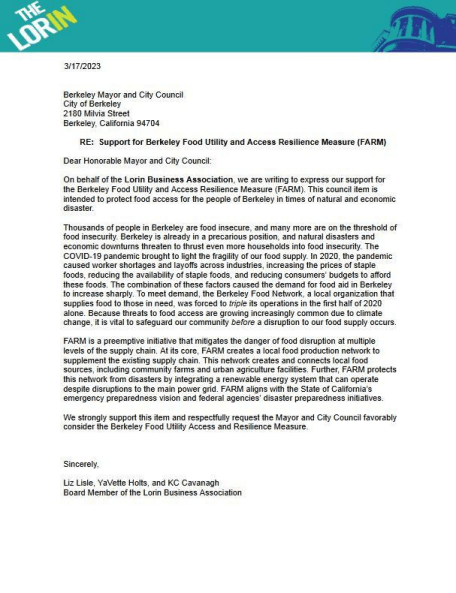
2. The Lorin Business Association Letter of Support
3. Alameda County Democratic Central Committee Letter of Support
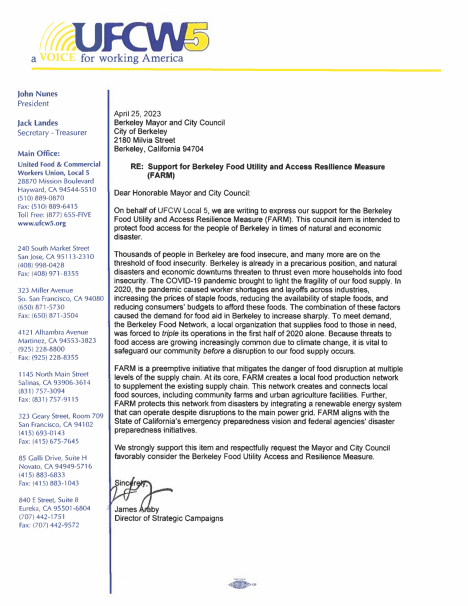
4. United Food & Commercial Workers 5 (UFCW 5) Letter of Support
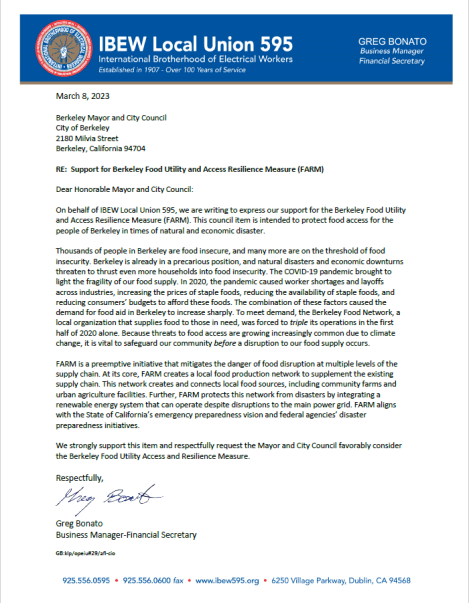
5. Building and Construction Trades Council of Alameda County, AFL-CIO Letter of Support 6. IBEW Local Union 595 Letter of Support
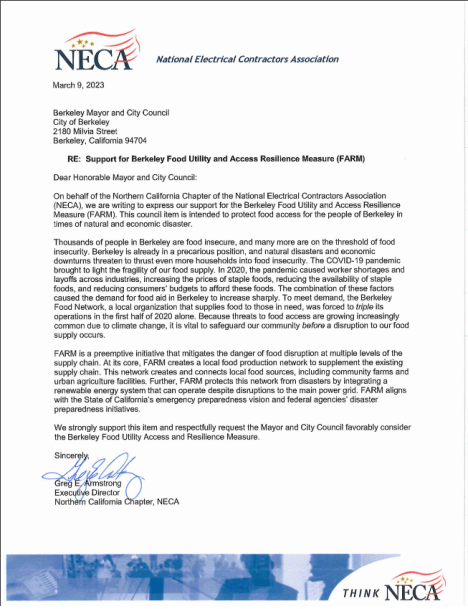
7. NECA Letter of Support
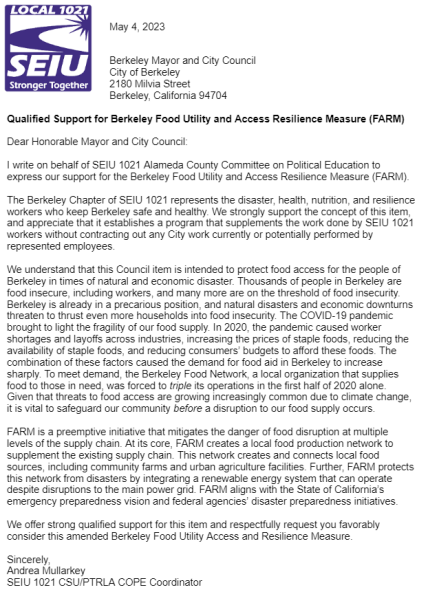
8. SEIU 1021 Letter of Support
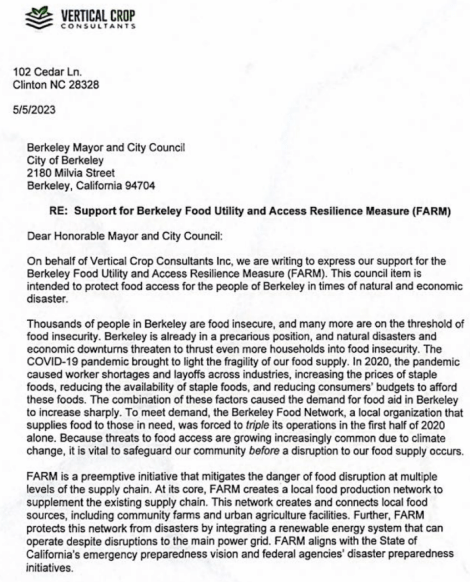
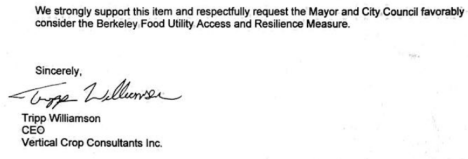
9. Vertical Crop Consultants Letter of Support
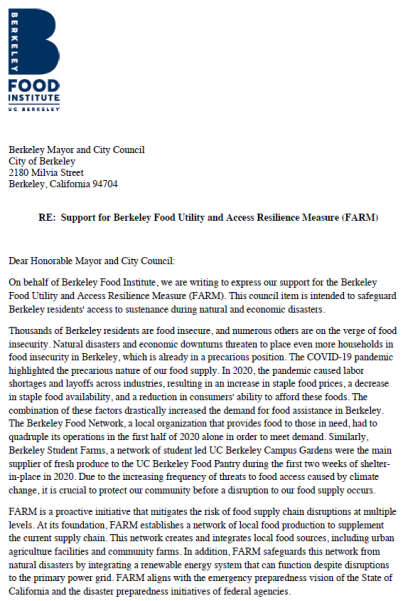
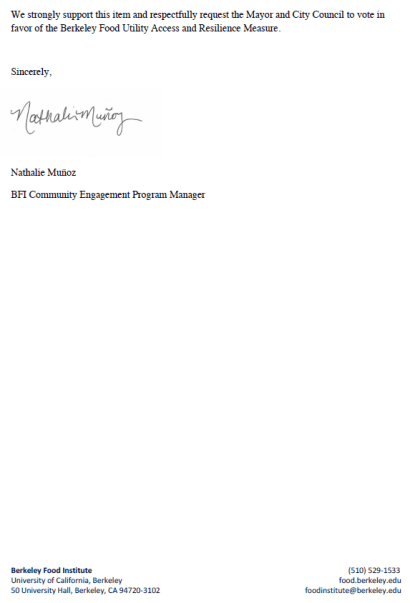
10. UC Berkeley Berkeley Food Institute Letter of Support
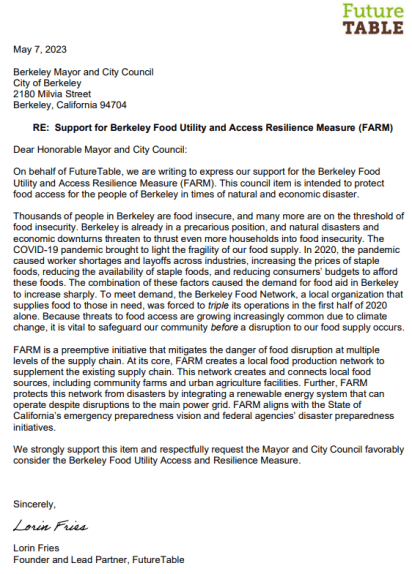
11. Future Table Letter of Support
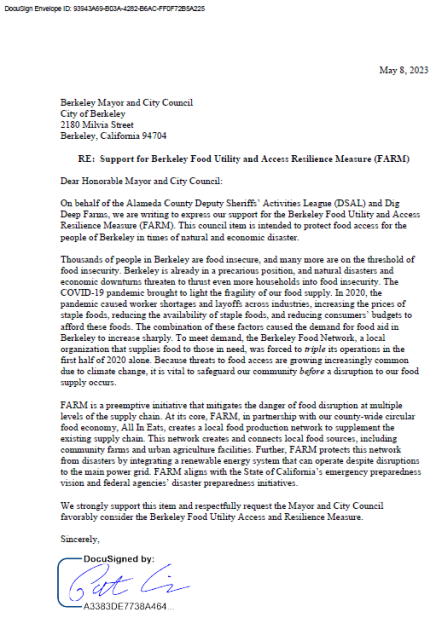
12. Dig Deep Farm (DSAL) Letter of Support
13. Photographs of Urban Farming Installations
2180 Milvia Street, Berkeley, Floor 5, CA 94704 ● Tel: (510) 981-7130 ● E-Mail: bbartlett@cityofberkeley.info 20
Attachment 1
RESOLUTION NO. ##,#### N.S.
A RESOLUTION OF THE BERKELELY CITY COUNCIL IN SUPPORT OF THE GOALS OF THE FOOD ACCESS AND RESILIENCE MEASURE (FARM) INITIATIVE AND THE DEVELOPMENT OF HYPERLOCAL URBAN FOOD PRODUCTION AND DISTRIBUTION WITH COMMUNITY-BASED ORGANIZATIONS
WHEREAS, the City of Berkeley and the Bay Area are experiencing increasing impacts of climate change, natural disasters, global conflicts, inflation, and food shortages; posing significant threat to the availability and economic accessibility of healthy foods; and
WHEREAS, the Berkeley Food Access and Resilience Measure (FARM) initiative calls for a self-funded community based organization, connecting producers, processors, distributors, retailers, and consumers to ensure food security in the community; and
WHEREAS, the FARM initiative will be governed by a Food Security Council; and
WHEREAS, the FARM initiative will be financed through a combination of government grants and private philanthropy; and
WHEREAS, the FARM initiative aligns with the goals of the Federal Government and State of California’s food and energy resilence policies and grants; and
WHEREAS, The City of Berkeley’s Climate Action Plan and Urban Agriculture Ordinance seeks to reduce pollution from the transportation of food by incentivizing urban farming and supporting local food production;
WHEREAS, the development and implementation of FARM will require collaboration with community-based organizations, SNAP recipients, organized labor, small businesses, and non-profit organizations;
NOW, THEREFORE, BE IT RESOLVED that the City of Berkeley hereby supports the goals of the Food Access and Resilience Measure (FARM) and the development of hyperlocal urban food production by providing incentives and funding opportunities for community based organizations;
BE IT FURTHER RESOLVED that the City of Berkeley will partner with community-based organizations implementing the goals of the FARM initiative.
THEREFORE, IT IS FURTHER RESOLVED that the City of Berkeley encourages the community, small businesses, labor organizations, and non-profits, to support the FARM initiative and
2180 Milvia Street, Berkeley, Floor 5, CA 94704 ● Tel: (510) 981-7130 ● E-Mail: bbartlett@cityofberkeley.info 21
participate in collaborative efforts to achieve food security and resilience within the City of Berkeley.
Attachment 2
2180 Milvia Street, Berkeley, Floor 5, CA 94704 ● Tel: (510) 981-7130 ● E-Mail: bbartlett@cityofberkeley.info 22
2180MilviaStreet, Berkeley, Floor5, CA94704●Tel: (510)981-7130●E-Mail: bbartlett@cityofberkeley.info 23

2180 Milvia Street, Berkeley, Floor 5, CA 94704 ● Tel: (510) 981-7130 ● E-Mail: bbartlett@cityofberkeley.info 24
Attachment 4
2180 Milvia Street, Berkeley, Floor 5, CA 94704 ● Tel: (510) 981-7130 ● E-Mail: bbartlett@cityofberkeley.info 25
Attachment 5

2180 Milvia Street, Berkeley, Floor 5, CA 94704 ● Tel: (510) 981-7130 ● E-Mail: bbartlett@cityofberkeley.info 26
Attachment 6
2180 Milvia Street, Berkeley, Floor 5, CA 94704 ● Tel: (510) 981-7130 ● E-Mail: bbartlett@cityofberkeley.info 27
Attachment 7
2180 Milvia Street, Berkeley, Floor 5, CA 94704 ● Tel: (510) 981-7130 ● E-Mail: bbartlett@cityofberkeley.info 28
Attachment 8
2180 Milvia Street, Berkeley, Floor 5, CA 94704 ● Tel: (510) 981-7130 ● E-Mail: bbartlett@cityofberkeley.info 29
Attachment 9
2180 Milvia Street, Berkeley, Floor 5, CA 94704 ● Tel: (510) 981-7130 ● E-Mail: bbartlett@cityofberkeley.info 30
2180MilviaStreet, Berkeley, Floor5, CA94704●Tel: (510)981-7130●E-Mail: bbartlett@cityofberkeley.info 31
2180MilviaStreet, Berkeley, Floor5, CA94704●Tel: (510)981-7130●E-Mail: bbartlett@cityofberkeley.info 32
Attachment 10
2180 Milvia Street, Berkeley, Floor 5, CA 94704 ● Tel: (510) 981-7130 ● E-Mail: bbartlett@cityofberkeley.info 33
2180MilviaStreet, Berkeley, Floor5, CA94704●Tel: (510)981-7130●E-Mail: bbartlett@cityofberkeley.info 34
Attachment 11
2180 Milvia Street, Berkeley, Floor 5, CA 94704 ● Tel: (510) 981-7130 ● E-Mail: bbartlett@cityofberkeley.info 35
Attachment 12
2180 Milvia Street, Berkeley, Floor 5, CA 94704 ● Tel: (510) 981-7130 ● E-Mail: bbartlett@cityofberkeley.info 36

2180MilviaStreet, Berkeley, Floor5, CA94704●Tel: (510)981-7130●E-Mail: bbartlett@cityofberkeley.info 37
Attachment 13
2180 Milvia Street, Berkeley, Floor 5, CA 94704 ● Tel: (510) 981-7130 ● E-Mail: bbartlett@cityofberkeley.info 38
 Home
Home 
Leave a comment